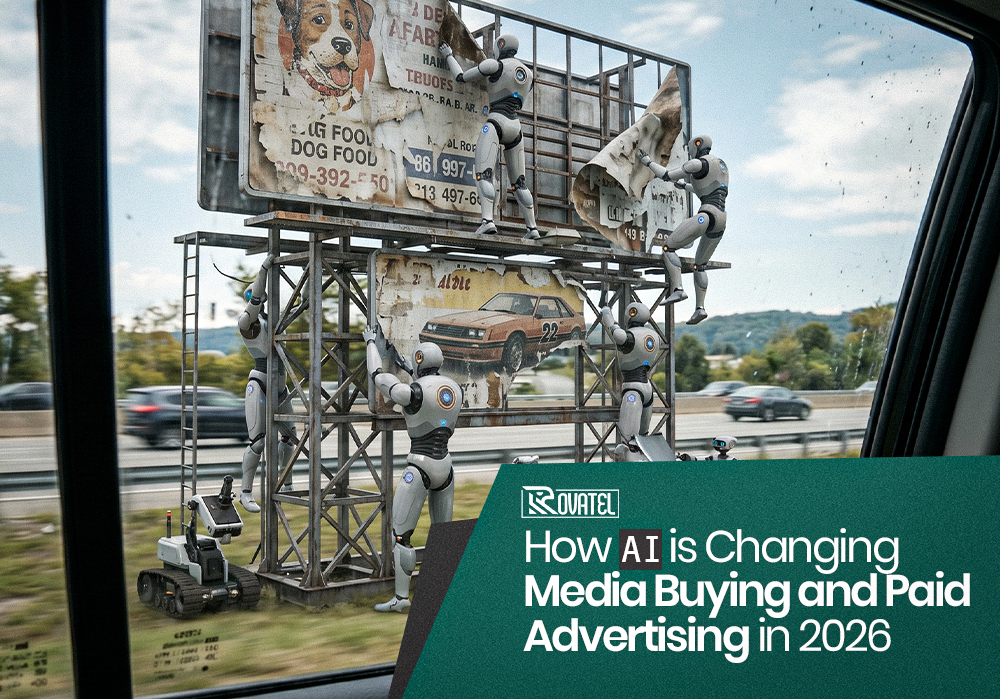
AI is changing media buying and paid advertising by transforming how marketers plan, execute, and optimize campaigns.
For years, advertising relied heavily on human decision-making, from audience targeting to budget allocation. Today, AI-powered tools can analyse data, automate decisions, and improve campaign performance in real time, making advertising more efficient and effective than ever before.
Today, that reality is changing.
Artificial Intelligence (AI) is rapidly transforming how brands plan, buy, manage, and optimize advertising campaigns. From audience targeting and real-time bidding to predictive analytics and creative testing, AI is becoming one of the most influential forces in modern media buying.
But despite the excitement surrounding automation, one truth remains: AI is making advertising smarter, not replacing strategy.
In this article, we’ll explore how AI is reshaping media buying and paid advertising in 2026, the opportunities it creates for brands, and why human creativity still matters more than ever.
What Is AI in Media Buying?
AI in media buying refers to the use of machine learning, predictive analytics, and automation technologies to make advertising decisions more efficiently and accurately.
Instead of relying solely on manual campaign management, AI systems can analyze vast amounts of data in real time and make adjustments that improve campaign performance.
These systems help advertisers:
– Identify high-value audiences
– Optimise bidding strategies
– Allocate budgets automatically
– Predict campaign outcomes
– Personalize ad experiences
– Improve conversion rates
The result is faster decision-making, reduced waste, and more efficient advertising spend.
Why AI Is Becoming Essential in Paid Advertising
The digital advertising landscape has become increasingly complex.
Consumers interact with brands across multiple platforms, devices, and channels. At the same time, privacy regulations, changing algorithms, and rising advertising costs make it harder for marketers to achieve consistent results.
AI helps solve these challenges by processing large volumes of data faster than any human team could.
Instead of reacting to performance reports after campaigns run, advertisers can now make adjustments in real time.
This shift is transforming paid advertising from reactive optimization to predictive optimization.
How AI Is Transforming Media Buying in 2026
1. Smarter Audience Targeting
One of the biggest advantages of AI in paid advertising is its ability to identify patterns in customer behavior.
Traditional targeting often relied on demographics such as age, gender, or location.
AI goes much deeper. Modern advertising platforms analyze:
- Browsing behaviour
- Purchase intent
- Content consumption patterns
- Engagement history
- Device usage
- Customer interests
This allows brands to reach audiences that are more likely to take action, rather than simply matching broad demographic categories.
Instead of asking, “Who are they?”
AI helps marketers answer, “What are they likely to do next?”
2. Automated Bidding and Budget Optimization
Manual bidding strategies are becoming less effective as advertising ecosystems become more complex.
AI-powered bidding systems continuously evaluate thousands of signals during every auction.
These signals include:
- User behavior
- Device type
- Time of day
- Location
- Historical conversion data
- Competition levels
The system then adjusts bids automatically to maximize results.
This helps advertisers achieve better performance while reducing wasted spend.
For brands operating with limited budgets, this level of efficiency can significantly improve return on investment.
3. Predictive Advertising and Forecasting
One of the most valuable applications of AI is prediction.
Rather than waiting for campaign results, AI can forecast likely outcomes before major spending decisions are made.
Predictive models can help marketers understand:
– Which audience segments are most likely to convert
– Which products may perform best
– Which campaigns may underperform
– How budget changes could impact results
This allows businesses to make more informed decisions and reduce advertising risk.
4. Dynamic Creative Optimization
Creating multiple ad variations has traditionally been a time-consuming process.
AI is changing that.
Dynamic Creative Optimization (DCO) enables advertising platforms to automatically combine different headlines, visuals, descriptions, and calls-to-action to identify the highest-performing combinations.
Instead of manually testing dozens of ad versions, AI continuously learns from user responses and serves the most effective creative variations.
This leads to improved engagement and better campaign performance over time.
5. Personalized Advertising at Scale
Consumers increasingly expect personalized experiences.
AI makes personalization possible across large audiences without requiring marketers to manually create thousands of different campaigns.
Modern advertising platforms can personalize:
– Product recommendations
– Ad copy
– Visual assets
– Promotional offers
– Landing page experiences
When executed effectively, personalized advertising creates more relevant customer experiences and stronger conversion opportunities.
What AI Cannot Replace
With so much automation available, it’s easy to assume AI will eventually handle every aspect of advertising.
That assumption would be a mistake.
While AI excels at processing data and identifying patterns, it cannot fully replicate human creativity, empathy, and strategic thinking.
AI can tell you what is happening.
People determine why it matters.
Successful advertising still depends on:
- Brand Positioning
AI cannot define what makes a brand unique. That requires human insight and strategic direction.
- Creative Storytelling
The most memorable campaigns are driven by emotion, cultural understanding, and creativity.
These are areas where human marketers continue to lead.
- Customer Understanding
Data reveals behavior.
Human insight reveals motivation.
Understanding why people make decisions remains essential for building campaigns that resonate.
Conclusion
AI is fundamentally changing media buying and paid advertising.
From audience targeting and predictive analytics to automated bidding and personalized experiences, AI is helping marketers make smarter decisions and achieve better results.
However, technology alone is not enough.
The future of paid advertising belongs to brands that combine the efficiency of AI with the creativity, strategy, and human understanding that technology cannot replicate.